.png)
General Liability vs. BOP: Which One Is Right for Your Business?

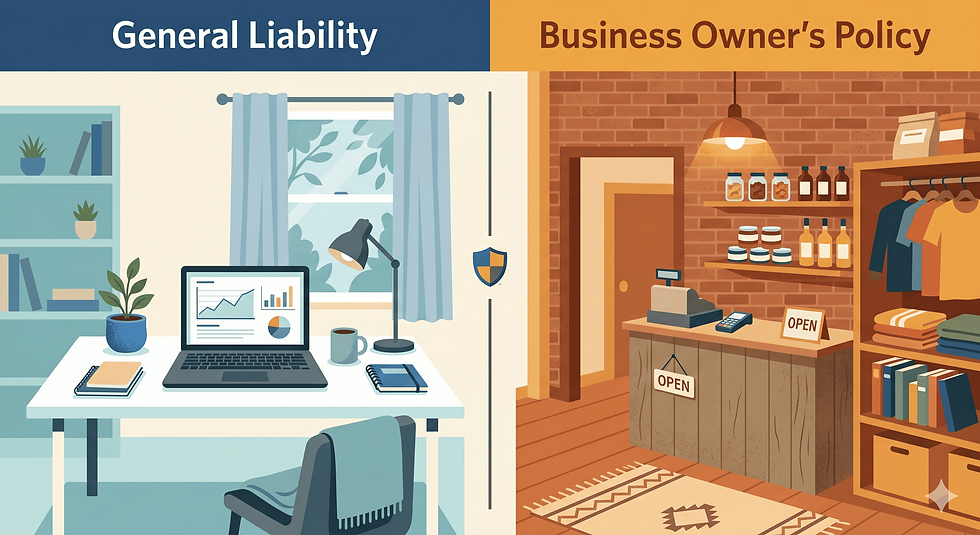
A General Liability (GL) policy covers third-party injury and property damage claims. A Business Owner's Policy (BOP) bundles GL with commercial property and business interruption coverage into one package. For most Connecticut small businesses with a physical location, a BOP offers broader protection at a better value. Sole proprietors and home-based operators may only need a GL policy.
The Question Every CT Business Owner Asks
You're a small business owner in Connecticut—maybe you run a boutique on Greenwich Avenue, manage a landscaping crew in Litchfield County, or operate a consulting practice from your home office in West Hartford. You know you need insurance. But then the options hit you: General Liability. Business Owner's Policy. And suddenly what felt like a straightforward task turns into alphabet soup.
This guide cuts through the confusion. We'll explain exactly what each policy covers, who each one is built for, and how to make the right call for your specific situation—using real-world examples from right here in Connecticut.
And if you'd rather skip the reading and get a fast, no-obligation comparison, our team here at Insure Connecticut LLC is ready.
What Is General Liability Insurance?
General Liability (GL) insurance is the foundation of commercial coverage. It protects your business against claims that your operations caused bodily injury or property damage to a third party—customers, vendors, or members of the public.
Think of it as your first line of financial defense. If a client trips over equipment at your job site in Stamford and breaks an arm, or if you accidentally damage a client's property while performing a service in Fairfield, GL steps in to cover legal defense costs, settlements, and medical payments.
What General Liability Covers
Bodily injury to third parties (customers, visitors, passersby)
Property damage caused by your business operations
Personal and advertising injury (libel, slander, copyright infringement in ads)
Medical payments for minor injuries regardless of fault
Legal defense costs and court-ordered judgments
What General Liability Does NOT Cover
Your own business property or equipment
Business income lost during a forced closure
Employee injuries (requires Workers' Compensation—mandated in CT for most employers)
Professional errors or negligence (requires E&O/Professional Liability)
Cyber incidents or data breaches
📎 External Reference: Learn more about commercial liability standards at the Insurance Information Institute
What Is a Business Owner's Policy (BOP)?
A Business Owner's Policy is a bundled insurance solution that combines General Liability with Commercial Property coverage and Business Interruption insurance into a single, streamlined policy. Insurers created the BOP specifically for small- to mid-size businesses that need more than liability protection—but don't yet require the complexity of a full commercial package policy.
For a florist in New Haven, a yoga studio in West Hartford, or an IT consultant with a leased office in Hartford's Asylum Hill neighborhood, a BOP is often the most cost-efficient and comprehensive starting point.
What a BOP Covers
Everything in General Liability (bodily injury, property damage, advertising injury)
Commercial property: your building or leased space, furniture, equipment, and inventory
Business interruption: replaces lost income if a covered event (fire, storm) forces a temporary closure
Optional endorsements: cyber liability, hired and non-owned auto, equipment breakdown, EPLI
What a BOP Does NOT Cover
Workers' compensation (separate policy—required by Connecticut law for most employers under CGS § 31-284)
Professional liability / E&O (separate policy for service-based businesses)
Commercial auto (separate policy if company vehicles are used)
Health, disability, or life insurance for owners or employees
📎 External Reference: Connecticut Insurance Department — consumer resources and complaint filings
General Liability vs. BOP: Side-by-Side Comparison
Coverage Feature | General Liability (GL) | Business Owner's Policy (BOP) |
Third-party bodily injury | ✅ Yes | ✅ Yes |
Third-party property damage | ✅ Yes | ✅ Yes |
Advertising / personal injury | ✅ Yes | ✅ Yes |
Commercial property coverage | ❌ No | ✅ Yes |
Business interruption/income loss | ❌ No | ✅ Yes |
Equipment breakdown | ❌ No | Optional add-on |
Cyber liability | ❌ No | Optional add-on |
Workers' compensation | ❌ No | ❌ No (separate policy) |
Professional liability (E&O) | ❌ No | ❌ No (separate policy) |
Typical annual premium (CT small biz) | $400–$900 | $750–$2,500+ |
Best for | Sole proprietors, contractors, home-based | Retail, restaurants, offices, service firms |
Who Should Choose General Liability Only?
A standalone GL policy is the right fit when your business has limited physical assets and your main risk exposure comes from your work or client interactions. These businesses typically benefit most from GL-only coverage:
Sole proprietors and freelancers: Graphic designers, writers, consultants, and photographers in CT who work from home or at client sites.
Contractors and tradespeople: Plumbers, electricians, and painters who need proof of insurance to win jobs—but whose tools are covered under a separate inland marine policy.
Home-based businesses: If you have no physical storefront and minimal business property, a BOP may include coverage you simply don't need.
Seasonal or part-time operations: A summer landscaper on the Shoreline or a holiday pop-up in Westport may find GL-only more cost-efficient.
Who Should Choose a BOP?
Most small-to-medium Connecticut businesses with a physical presence are better served by a BOP. Use this qualifying checklist:
Qualifying Criteria | Your Answer |
Do you own or lease a physical business location? | ☐ Yes ☐ No |
Do you have business personal property (equipment, inventory)? | ☐ Yes ☐ No |
Is your annual revenue under $5 million? | ☐ Yes ☐ No |
Are you in a low-to-moderate risk industry? | ☐ Yes ☐ No |
Do you need business interruption coverage? | ☐ Yes ☐ No |
⭐ If 3 or more answers are YES → You likely qualify for and should consider a BOP | |
How Much Does Each Policy Cost in Connecticut?
Premiums vary based on industry, payroll, revenue, claims history, and coverage limits. Here are realistic ranges for Connecticut small businesses:
General Liability only: $400–$900/year for a low-risk business (e.g., a home-based consultant). Higher-risk industries like roofing or tree service can exceed $3,000/year.
Business Owner's Policy: $750–$2,500+/year for a typical small business. The bundled discount usually makes a BOP 10–20% cheaper than buying GL and commercial property separately.
Important: Connecticut businesses in flood-prone areas — along Long Island Sound in Old Saybrook, Westport, or New London — should note that neither GL nor BOP covers flood damage. Separate flood coverage through the NFIP may be required.
📎 External Reference: FEMA National Flood Insurance Program (NFIP)
Why Independent Brokers Matter: The Insure Connecticut LLC Difference
Choosing between a GL policy and a BOP sounds straightforward — until you get into the details. Industry classification codes, sub-limits, endorsement options, and carrier appetites all vary significantly. A policy perfectly structured for a Gold Coast financial advisor may leave a Litchfield Hills contractor dangerously underinsured.
That's where working with an independent broker like Insure Connecticut LLC makes a real difference. Unlike captive agents who represent a single carrier, we work with dozens of A-rated insurers and shop the market on your behalf—finding the right coverage at the most competitive price.
Local knowledge: We understand the specific risks and regulatory environment Connecticut businesses face—from Hartford's commercial districts to the shoreline communities of New Haven County.
No sales pressure: We're advisors first. We'll tell you honestly if a GL policy is all you need or if a BOP is worth the added investment.
Ongoing policy review: Business needs evolve. We proactively review your coverage as your business grows so you're never caught underinsured.
One call, multiple quotes: We shop multiple carriers simultaneously, saving you hours of phone calls and comparison shopping.
Ready to find out which policy fits your business?
General Liability vs. BOP Insurance in Action
Scenario 1
A Hartford-Based IT Consultant
Maria runs a freelance IT consulting firm out of her home office in West Hartford. She has no physical storefront, works at client sites, and her main assets are a laptop and two monitors. A general liability policy at approximately $600/year covers her core exposure. A BOP would bundle in commercial property coverage she doesn't need. GL-only wins.
Scenario 2
A Boutique Owner on Greenwich Avenue
James owns a specialty home goods shop in Greenwich. He carries $80,000 in inventory and signs a lease requiring proof of property coverage. A BOP protects his inventory, covers build-out improvements, and includes business interruption if a burst pipe forces a two-week closure. A BOP is clearly the right choice.
Scenario 3
A Landscaping Crew in Litchfield County
Rosa runs a 4-person landscaping company in the Litchfield Hills. She has a small equipment shed and commercial vehicles. She needs GL (for on-site liability), a commercial auto policy, and a separate inland marine policy for equipment. Her broker at Insure Connecticut LLC builds a customized package covering all three gaps without overlaps.
Frequently Asked Questions
Does a BOP replace my General Liability insurance?
Yes. A BOP includes General Liability as a core component. You do not need to carry both a standalone GL and a BOP — it would be redundant and unnecessarily expensive.
Is General Liability required by law in Connecticut?
Connecticut does not universally mandate GL for all businesses, but many industries, landlords, and government contracts require it. Contractors bidding on state or municipal projects in CT are almost always required to carry minimum GL limits.
Can I add cyber liability to my BOP in Connecticut?
Yes, many carriers offer cyber liability as an endorsement to a BOP. Given that Connecticut's data breach notification law (CGS § 36a-701b) imposes strict obligations on businesses that experience a breach, this add-on is worth serious consideration.
What if my business grows—can I switch from GL to a BOP?
Absolutely. This is one of the most common coverage upgrades we handle at Insure Connecticut LLC. As your business acquires property, inventory, or moves into a leased space, upgrading to a BOP is a smart and seamless transition.
Are BOPs available for restaurants and food service businesses in CT?
Yes, though some carriers have specific appetite restrictions based on liquor service, square footage, or hours of operation. An independent broker can identify the best BOP options for your Connecticut food service business.
Stop Guessing—Get the Right Coverage
The General Liability vs. BOP decision comes down to one core question: does your business have physical assets and income that need protecting beyond liability exposure? If yes, a BOP is almost always the smarter investment. If you're a lean, home-based, or sole-proprietor operation, GL-only may be all you need—for now.
But 'for now' is the key phrase. Business insurance should grow with your business, and the best way to make sure it does is to work with someone who knows both the insurance landscape and the Connecticut market.
Ready to Get the Right Coverage for Your CT Business?
Get a free, no-obligation quote or schedule a policy review with Insure Connecticut LLC. Call us at (860) 970-0977 or fill out our form below.


Comments