.png)
Workers' Compensation Insurance for Hair Salons and Barber Shops in Connecticut


If you run a hair salon or barbershop in Connecticut and have even one person working for you—full-time, part-time, or seasonal—state law says you need workers' compensation insurance. That surprises a lot of salon owners, especially those coming from a booth-rental model where everyone is technically self-employed.
Salons look low-risk on the surface, but the claims add up: a stylist nicked by shears, a chemical burn from color developer, a slip on a wet floor near the shampoo bowl, or a repetitive strain injury in someone's wrist after years of cutting and blow-drying. Workers' comp is what pays the medical bills and lost wages when that happens—and it's what keeps a single injury from becoming a lawsuit against your business.
This guide walks through what workers' compensation insurance actually is, who in your salon needs to be covered under Connecticut law, what it typically costs, and how to get a quote—whether you want to buy online or work with a local independent insurance broker who can shop multiple carriers for you.
Table of Contents
What Is Workers' Compensation Insurance?
Workers' compensation insurance is a policy that pays medical expenses and a portion of lost wages when an employee is hurt or gets sick because of their job — regardless of who was at fault. In exchange, the employee generally gives up the right to sue the employer directly over that injury. It's a trade-off that protects workers and shields business owners from open-ended liability.
For a salon, that means if a colorist develops a chemical burn from bleach, or a barber slices a finger with clippers, workers' comp pays for the ER visit, follow-up care, and a share of the wages lost during recovery — without your business absorbing the cost out of pocket or facing a personal injury claim.
Does Your Connecticut Salon Legally Need It?
Yes, in almost every case. Under the Connecticut Workers' Compensation Act, employers with even one employee—full-time, part-time, or seasonal—are required to carry coverage. There's no minimum payroll or minimum hours threshold that gets you out of it.
A few narrow exceptions exist: sole proprietors with no employees, LLC members, and corporate officers can elect to exclude themselves from coverage using specific state forms, though many choose to stay covered anyway since a serious injury could otherwise wipe out personal savings. Household employees working fewer than 26 hours a week are also exempt. Everyone else on staff—stylists, colorists, receptionists, shampoo assistants, and apprentices—needs to be covered.
Operating without required coverage in Connecticut exposes a salon owner to fines, potential imprisonment for willful non-compliance, and full personal liability for any workplace injury costs. It can also jeopardize your cosmetology or barbering shop license during state inspections.
Who Counts as an "Employee" in a Salon?
This is where a lot of confusion happens, especially in salons that rent chairs or booths.
W-2 stylists and barbers on payroll — clearly employees, must be covered.
1099 booth renters — if they're genuinely independent, running their own business, setting their own hours, and paying their own booth rent, they're typically not your employees for workers' comp purposes. But misclassification is a common and costly mistake; if the state or your carrier determines a "renter" is functioning like an employee, you could be on the hook for unpaid premiums and penalties.
Part-time and seasonal help — still counts. Connecticut doesn't exempt part-timers.
Family members — generally still need to be covered unless a specific exclusion applies.
If your business model mixes booth renters and payroll staff, it's worth having an agent review your actual working arrangements rather than assuming your 1099s keep you clear of the requirement.
What Workers' Comp Covers for Salons and Barbershops
A standard policy typically covers:
Medical treatment for job-related injuries and illnesses
A percentage of lost wages during recovery (Connecticut caps benefits at a maximum weekly rate set annually by the state)
Physical therapy and ongoing care
Disability benefits for temporary or permanent impairment
Death benefits and funeral costs in the rare case of a fatal workplace incident
Mileage reimbursement for medical appointments related to the injury
Common Salon Injuries and Real Claims Scenarios
Salons carry a moderate risk profile—lower than construction, but higher than a typical office. Frequent sources of claims include:
Repetitive strain injuries in wrists, shoulders, and hands from cutting, coloring, and blow-drying all day
Chemical burns and skin reactions from bleach, developer, relaxers, and other salon chemicals
Slip-and-fall accidents from wet floors, hair clippings, or cords near styling stations
Cuts and puncture wounds from scissors, razors, and clippers
Respiratory irritation from aerosol products and fumes in poorly ventilated spaces
None of these are dramatic, but they're common enough that "we're just a small salon" isn't a reason to skip coverage—it's often the reason claims happen quietly and add up over time.
What Does Workers' Comp Insurance Cost for a CT Salon?
Salons and barbershops are rated under NCCI class code 9586 (Barber Shop, Beauty Parlor, or Hair Styling Salon), which covers services involving hair, scalp, face, and hands. Nationally, salons average around $0.49–$0.52 per $100 of payroll — roughly $19 per employee, per month, before taxes and fees.
Your actual Connecticut rate depends on:
Payroll — the biggest single driver of premium
Class code accuracy — misclassifying stylists under the wrong code can inflate or misstate your rate
Experience Modification Rate (EMR) — your claims history relative to similar businesses; new salons typically start at a neutral 1.0
Carrier and market conditions — rates vary between insurance companies
Connecticut's approved rates change periodically, so treat any number here as a planning estimate, not a quote. The most accurate way to see your real premium is to run your payroll and class code through a licensed agent or carrier.
Where to Get Workers' Comp Insurance: Agent vs. Buying Online
Connecticut salon owners generally have two paths:
1. Buy workers' comp insurance online directly from a carrier.
Some Connecticut salon owners buy workers' comp insurance online directly through a national carrier—a workers' comp insurance quote and policy can sometimes be issued in minutes this way. It can work for a very simple, single-location salon with straightforward payroll. But going direct means you're only seeing one company's rate, you're the one catching class-code or payroll errors before they cost you at audit time, and if your salon mixes booth renters with W-2 staff, most online tools aren't built to handle that nuance. That's where a licensed independent agent earns their keep.
2. Work with an independent insurance broker.
Working with Insure Connecticut LLC makes shopping for workers' compensation insurance easy. We compare quotes from multiple top-rated insurance companies, help prevent costly payroll or class-code errors, and provide expert guidance if you have both employees and booth renters. When a claim happens, you'll have a dedicated insurance professional on your side.
Ready to protect your salon? Contact us today at (860) 970-0977 and request a free workers' compensation insurance quote, and let us help you find the right coverage at a competitive price.
How to Get the Cheapest Workers' Comp Insurance (Without Cutting Coverage)
"Cheapest workers' comp insurance" and "adequate coverage" aren't opposites if you approach them right:
Classify employees correctly. Getting class code 9586 applied accurately—instead of a generic or higher-risk code—is the single biggest lever on price.
Report payroll accurately, not conservatively. Underreporting payroll to lower premiums leads to a costly bill at your year-end audit.
Bundle with general liability. Many small business workers' compensation insurance companies offer better combined pricing through a Business Owner's Policy (BOP) paired with workers' comp.
Maintain a clean claims record. Basic safety measures — non-slip mats, proper ventilation, staff training on chemical handling — reduce claims and keep your experience mod favorable over time.
Compare more than one quote. Rates for the same class code and payroll can vary meaningfully between carriers.
How to File a Workers' Comp Claim in Connecticut
Get the employee medical care immediately. Safety comes first, paperwork second.
Document the incident — date, time, location, what happened, and any witnesses.
Report the injury to your insurance carrier promptly; most policies require prompt notice.
Have the employee file Form 30C with the Connecticut Workers' Compensation Commission within one year of the injury (three years for an occupational disease) to preserve their rights.
Cooperate with the claims adjuster as the case moves through the Connecticut Workers' Compensation Commission, which oversees disputes and voluntary agreements between employer, employee, and carrier.
Workers' compensation insurance claims in Connecticut cannot be reopened once a settlement is finalized and mutually agreed upon, so accuracy at the claims stage matters for both sides.
Common Mistakes Salon Owners Make
Assuming booth renters remove the requirement entirely. Even one payroll employee — a receptionist, an assistant — triggers the law.
Skipping coverage because the salon is "small." There's no employee-count minimum in Connecticut.
Misclassifying staff under the wrong class code, which distorts pricing and can cause audit disputes.
Underreporting payroll to get a lower quote, which surfaces (and costs more) at annual audit.
Letting the officer-exclusion form lapse or never filing it, leading to confusion about who is actually covered.
Not updating the policy when hiring—new stylists need to be added, not assumed covered.
Checklist: Workers' Comp for CT Salon Owners
Confirm your business has at least one W-2 employee (this triggers the CT requirement)
Identify which staff are true 1099 booth renters vs. employees
Confirm your policy uses class code 9586.
Gather annual payroll by role for an accurate quote
Compare quotes from at least two or three sources—online carrier and/or independent agent
File officer/LLC exclusion forms if applicable and desired
Post the required workplace notice about workers' comp rights
Review coverage annually or whenever you hire, add booth renters, or expand payroll
Expert Tip
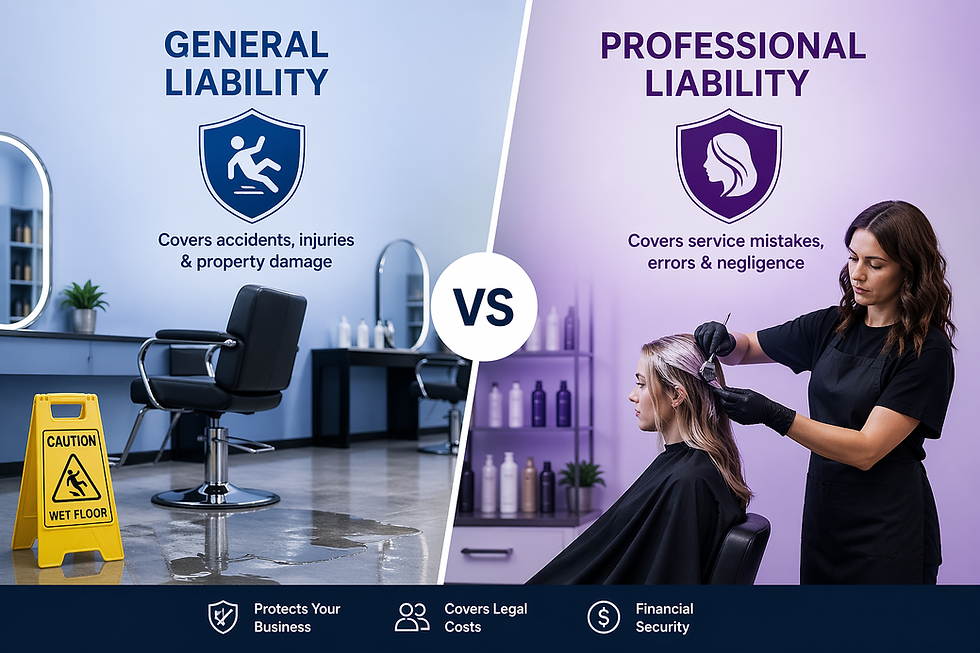
A lot of salon owners assume their general liability or BOP already includes workers' comp. It doesn't — general liability covers injuries to customers and property damage, while workers' comp is specifically for your employees' on-the-job injuries. You need both, and in Connecticut, workers' comp isn't optional once you have staff on payroll.
Frequently Asked Questions
What is workers compensation insurance?
It's a policy that pays medical costs and partial lost wages for employees injured or made ill by their job, regardless of fault, while limiting the employer's liability for that injury.
Do I need workers' comp if I only have one part-time stylist?
Yes. Connecticut requires coverage for employers with even one employee, whether full-time, part-time, or seasonal.
Do booth renters count as employees?
Not usually, if they're genuinely independent contractors running their own business within your space. Misclassifying them can create liability, so it's worth having an agent confirm your setup.
How much does workers' comp cost for a hair salon?
Nationally, salons average roughly $0.49–$0.52 per $100 of payroll under class code 9586, or about $19 per employee monthly. Actual Connecticut rates depend on payroll, claims history, and carrier.
Where can I get a workers compensation insurance quote?
Through a licensed independent agent, who can compare multiple carriers, or directly online through carriers like BiBERK, Pie, Next Insurance, or The Hartford.
Can I buy workers comp insurance online?
Yes, several carriers offer online applications and same-day binding for straightforward, single-location salons. More complex setups (multiple locations, mixed booth-rental and payroll staff) often benefit from an agent's review.
What's the cheapest way to get workers' comp coverage?
Accurate employee classification, correct payroll reporting, bundling with general liability, and comparing quotes from multiple workers compensation insurance companies are the most reliable ways to lower cost without gaps in coverage.
What happens if I don't carry workers' comp in Connecticut?
You risk fines up to $50,000, potential imprisonment for willful violations, full personal liability for any workplace injury costs, and possible issues renewing your salon or cosmetology license.
How do I file a workers' comp claim in Connecticut?
Get the employee medical care, document the incident, report it to your carrier promptly, and have the employee file Form 30C with the CT Workers' Compensation Commission within one year of the injury.
Does the salon owner need to be covered too?
Sole proprietors, LLC members, and corporate officers can elect to exclude themselves using state forms, but many keep coverage since a serious injury could otherwise fall entirely on personal finances.
What class code applies to hair salons and barbershops?
NCCI class code 9586—Barber Shop, Beauty Parlor, or Hair Styling Salon—which covers hair, scalp, face, and hand grooming services.
Conclusion
Connecticut doesn't give salons and barbershops a pass on workers' comp just because the industry looks low-risk. One employee is enough to trigger the requirement, and the everyday realities of the job — chemicals, sharp tools, wet floors, repetitive motion — mean claims happen more often than owners expect. The good news is that coverage for a typical salon is affordable relative to riskier industries, and getting a quote takes little more than your payroll numbers and staff count.
Whether you're setting up coverage for the first time, adding a new hire, or just want to confirm your current policy actually reflects how your salon operates — booth renters and all — it's worth a conversation with someone who knows Connecticut's rules specifically.
Running a salon or barbershop in Connecticut? Insure Connecticut LLC can review your current setup—including mixed booth-rental and payroll staff—and shop your workers' comp coverage across multiple carriers to find the right fit at a competitive rate. To get started, fill out our quote request form by clicking the button below.

Comments