.png)
Flood Insurance in Connecticut: What Your Homeowner's Policy Won't Cover

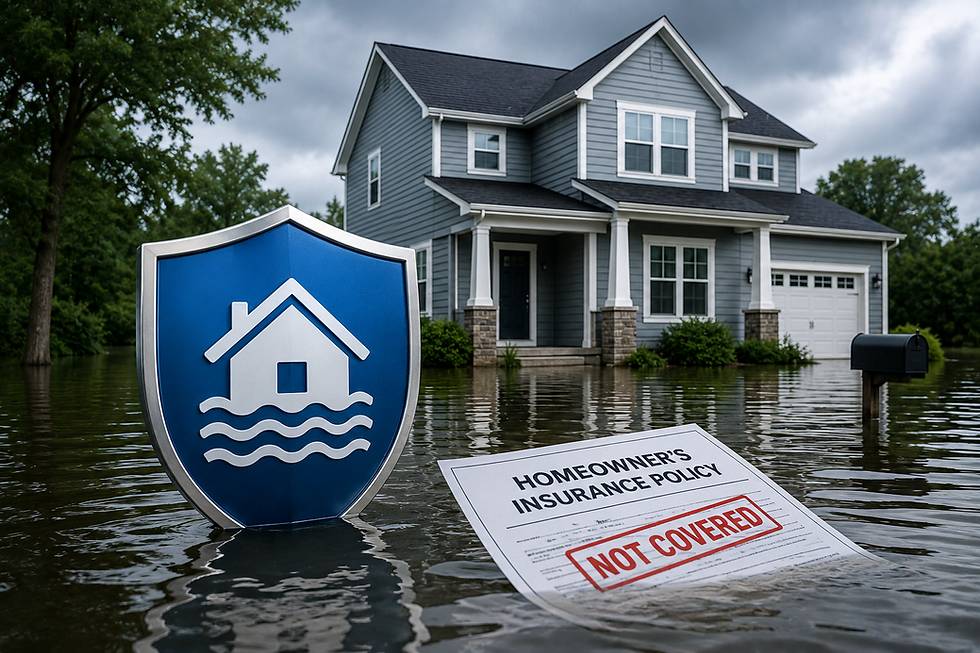
If a pipe bursts under your kitchen sink, your Connecticut homeowners policy pays for it. If the Housatonic River overflows its banks after a week of heavy rain, or a nor'easter pushes Long Island Sound into your basement, that same policy pays for nothing. That distinction surprises a lot of homeowners, usually at the worst possible moment: right after the water recedes and the adjuster tells them flood damage was never part of their coverage to begin with.
Connecticut has more than 90 miles of Long Island Sound coastline and hundreds of inland rivers and streams feeding into it, which means flood exposure isn't limited to waterfront property. The August 2024 flash flooding that hit parts of the state is a recent reminder that severe rain events can overwhelm drainage far from the coast. Understanding exactly where your homeowners policy stops and how flood insurance picks up from there is the difference between a manageable claim and an uninsured disaster.
Table of Contents
Why Your CT Homeowners Policy Doesn't Cover Flood Damage
Every standard homeowners insurance policy, including the HO3 form most Connecticut homeowners carry, contains a water damage exclusion that specifically carves out flood. Insurers define flood narrowly and consistently across the industry: surface water that rises and touches two or more acres or two or more properties, storm surge, overflow of a river, stream, or lake, or mudflow. If the water source is external and ground-level, it's a flood, and it's excluded, full stop.
That's different from water damage your HO3 policy does cover, which generally involves water originating inside the structure or falling directly from the sky onto your roof—a burst supply line, an overflowing washing machine, or a sudden roof leak during a storm. The Connecticut Insurance Department's guidance on storm water and flood coverage walks through this distinction in detail, and it's worth reading before you assume any water-related claim will be treated the same way.
The exclusion exists because flood risk is geographically concentrated and potentially catastrophic in a way most insurers can't spread across a standard book of business. That's exactly why a separate federal program was created to cover it.
What a Standard HO3 Policy Does and Doesn't Cover
Water Event | Covered by HO3? | Why |
Burst or frozen pipe | Yes | Sudden, internal water discharge |
Roof leak during a storm | Yes | Wind/rain damage to the structure |
Washing machine overflow | Yes | Internal appliance malfunction |
Ice dam backup | Usually | Sudden and accidental interior damage |
Sewer or drain backup | No, unless endorsed | Requires a separate endorsement |
Groundwater seepage | No | Considered gradual, not sudden |
River or stream overflow | No | Meets the policy's flood definition |
Storm surge / coastal flooding | No | Meets the policy's flood definition |
Flash flooding from heavy rain | No | Surface water, excluded as flood |
The sewer/drain backup line is one of the most misunderstood gaps. Many CT homeowners assume a flooded basement from a backed-up sewer line is a flood claim, or conversely assume it's automatically covered. In reality, it's neither—it needs its own endorsement, separate from both your HO3 policy and a flood policy.
NFIP Flood Insurance: Coverage, Limits, and What's Changing in 2026
For most Connecticut homeowners, flood coverage starts with the National Flood Insurance Program (NFIP). Every municipality in Connecticut participates in the NFIP, according to the Connecticut DEEP's flood management overview, so NFIP policies are available statewide regardless of your specific flood zone designation.
A few things to know before you buy:
Coverage caps. NFIP residential policies max out at $250,000 for the building and $100,000 for contents. For higher-value homes, especially along the Fairfield County shoreline or in larger Litchfield Hills properties, that ceiling can fall well short of full replacement cost.
Waiting period. New NFIP policies generally take 30 days to take effect. You can't buy coverage the week a storm is forecast and expect it to help.
Rate increases are capped, not frozen. Since FEMA rolled out Risk Rating 2.0, annual premium increases for primary residences are capped at 18% by federal law (25% for non-primary and commercial properties), and increases continue until a policy reaches its calculated full-risk rate. If your CT home has been paying a subsidized rate, expect gradual increases for several more years.
Reauthorization deadline. Congress most recently extended NFIP's authorization to September 30, 2026. The FEMA reauthorization page notes that if Congress doesn't act by that deadline, FEMA would stop issuing new or renewal policies, though existing policies and claims payments would continue. This has happened before and been resolved retroactively, but it's a real deadline worth watching if you're closing on a home or renewing coverage this fall.
Private Flood Insurance vs. NFIP: Which Fits Your CT Home
Private flood insurance has expanded significantly in Connecticut over the past several years, and for a meaningful number of homeowners, it's now a better fit than NFIP.
Factor | NFIP | Private Flood Insurance |
Building coverage limit | $250,000 max | Often $500,000+ available |
Contents coverage limit | $100,000 max | Often higher, sometimes replacement cost |
Waiting period | Typically 30 days | Often shorter, sometimes none |
Additional living expenses | Not included | Frequently included |
Rate stability | Statutory glide path, gradual increases | Varies by carrier, can be non-renewed |
Lender acceptance | Always accepted | Accepted if it meets federal "at least as broad" equivalence standard |
Best fit for | Baseline/mandatory coverage, lower-value homes | Higher-value homes, basements, faster coverage needs |
Federal law requires lenders to accept a qualifying private flood policy in place of NFIP, so switching doesn't jeopardize your mortgage as long as the private policy is written to meet that equivalence standard. The trade-off is that private carriers can choose not to renew a policy after a bad claims year, while NFIP guarantees renewal as long as premiums are paid. For a lot of Connecticut homeowners, the right answer isn't either/or—it's an NFIP policy for the base layer plus a private excess policy above the federal caps.
Who in Connecticut Actually Needs Flood Insurance
Flood risk in Connecticut isn't confined to a postcard image of beachfront property. Two distinct risk patterns show up across the state:
Coastal flooding
Affects Long Island Sound shoreline communities—Fairfield County's Gold Coast towns, New Haven's shoreline neighborhoods, and towns further up the coast—through storm surge and tidal flooding during nor'easters and hurricanes.
Inland flooding
Follows heavy rain and rapid snowmelt along river systems — the Housatonic River corridor, the Farmington Valley, and tributaries throughout the Litchfield Hills — and increasingly along the I-95 and I-84 corridors where development has outpaced stormwater infrastructure.
If your home sits outside a FEMA-mapped high-risk zone, you're not automatically safe. FEMA's maps are periodically updated, and Fairfield County in particular has newer maps rolling out that could move previously low-risk properties into zones where lenders will require coverage. A property reclassified from a low-risk to a high-risk zone can trigger a new mandatory purchase requirement mid-mortgage, not just at closing.
Common Coverage Gaps CT Homeowners Miss
Finished basements. Flood policies limit coverage for basement contents and finishes even when the building itself is well covered—know the sub-limits before you finish that basement.
Sewer and sump pump backup. Neither your HO3 policy nor a standard flood policy automatically covers this. It requires its own endorsement.
Additional Living Expenses (ALE). NFIP does not cover the cost of temporary housing while your home is repaired. Private flood policies sometimes do—check before assuming you're covered.
Detached structures. Garages, sheds, and other detached structures often need separate consideration under both flood and homeowners coverage.
Landscaping and pools. Excluded from most flood policies and often from homeowners coverage too.
How to Get Flood Insurance in Connecticut
Check your flood zone. Confirm your FEMA flood zone designation, since this affects both cost and whether coverage is mandatory under your mortgage.
Review your current HO3 policy. Identify exactly what water damage is and isn't covered, including whether you already have a sewer backup endorsement.
Get quotes for both NFIP and private flood insurance. Compare limits, waiting periods, and price, especially if your home's replacement cost exceeds NFIP's caps.
Ask about Community Rating System discounts. Several Connecticut communities participate in FEMA's Community Rating System, which can reduce NFIP premiums for homes in Special Flood Hazard Areas.
Bind coverage before you need it. Given the 30-day NFIP waiting period, don't wait for a storm forecast to start this process.
Revisit coverage after any flood map update or major renovation. A finished basement, an addition, or a remapped zone can all change what you need.
Expert Tips
If you're on a mortgage in a Special Flood Hazard Area, your lender already requires flood insurance — but "meeting the requirement" and "having adequate coverage" aren't the same thing. Many homeowners buy the minimum required and remain underinsured for their actual rebuild cost.
If your home was previously grandfathered into a lower flood insurance rate, that protection is transitioning under Risk Rating 2.0. Ask your agent whether an elevation certificate could still lower your premium under the new methodology.
Even outside a mapped flood zone, consider a Preferred Risk-style low-cost policy. A large share of NFIP claims nationally come from properties outside high-risk zones.
Common Mistakes to Avoid
Assuming "water damage" coverage in your HO3 policy includes flooding. It almost never does.
Waiting until a storm is in the forecast to buy flood insurance. The waiting period will leave you exposed.
Insuring only to your mortgage requirement. The lender's minimum isn't the same as full protection for your home's actual value.
Overlooking sewer/sump backup coverage. This is one of the most common basement claim denials in Connecticut.
Not reviewing coverage after a flood map update. Fairfield County's newer maps are reclassifying properties that weren't previously considered high-risk.
Frequently Asked Questions
Does homeowners insurance cover flood damage in Connecticut?
No. Standard HO3 homeowners policies specifically exclude flood damage, defined as surface water from storm surge, overflowing rivers, or widespread rainfall runoff. You need a separate flood insurance policy.
What's the difference between water damage and flood damage?
Water damage from an internal source, like a burst pipe or an overflowing appliance, is typically covered under your homeowners policy. Flood damage from an external, ground-level source affecting a wide area is excluded and requires flood insurance.
Is flood insurance required in Connecticut?
It's only legally required if your home is in a FEMA-designated Special Flood Hazard Area and you have a federally backed or regulated mortgage. Outside that requirement, it's optional but often still worth carrying given Connecticut's coastal and inland flood exposure.
How much does flood insurance cost in Connecticut?
Cost varies significantly based on flood zone, elevation, coverage limits, and whether you choose NFIP or private coverage. Homes in high-risk coastal zones typically pay more than inland, low-risk properties. Ask your agent for a property-specific quote rather than relying on statewide averages.
What does NFIP flood insurance cover?
NFIP covers the building structure up to $250,000 and contents up to $100,000 for residential properties, subject to specific exclusions like ALE, landscaping, and certain basement finishes.
Can I buy private flood insurance instead of NFIP?
Yes. Federal law requires lenders to accept qualifying private flood policies that meet an equivalence standard. Private insurance can offer higher limits and sometimes shorter waiting periods, though it may not guarantee renewal the way NFIP does.
How long is the waiting period for flood insurance?
NFIP policies typically take 30 days to take effect. Private flood policies sometimes offer shorter waiting periods, which can matter if you're closing on a home quickly.
Will my flood insurance cover a finished basement?
Only partially. Basement contents and finishes have specific sub-limits under NFIP policies, and coverage details vary by private carrier. Review the fine print before assuming your finished basement is fully protected.
Does flood insurance cover sewer backup?
No. Sewer and sump pump backup is excluded from both standard homeowners policies and flood insurance policies. It requires its own endorsement.
What happens if the NFIP program lapses?
NFIP is currently authorized through September 30, 2026. If Congress doesn't reauthorize it by then, FEMA would stop issuing new or renewal policies, though existing policies would remain in effect and claims would continue to be paid. Private flood insurance is unaffected by an NFIP lapse.
Do I need flood insurance if I'm not near the water?
Possibly. Inland flooding from heavy rain events affects river corridors like the Farmington Valley and Litchfield Hills, and flash flooding can occur well outside mapped high-risk zones.
Conclusion
The line between what your Connecticut homeowners policy covers and what it doesn't isn't obvious until you're standing in a flooded basement reading the fine print for the first time. A burst pipe, a leaky roof, an overflowing appliance—your HO3 policy handles those. Rising water from a storm, a swollen river, or a coastal surge is a different category entirely, and it takes a dedicated flood policy, whether through NFIP or a private carrier, to close that gap.
Whether you're on the Fairfield County coastline, along the Farmington River, or anywhere in between, the right move is reviewing your actual exposure before the next storm decides for you. Insure Connecticut LLC can walk you through your flood zone, compare NFIP and private flood insurance side by side, and make sure your coverage actually matches your home's value — not just your lender's minimum. Request a homeowners and flood insurance review to see where your current policy leaves you exposed.


Comments