.png)
Why Does Your Martha’s Vineyard Secondary Home Need a Primary Insurance Strategy?
- W. Tom Polowy, MS

- Apr 11
- 7 min read
Owning a home on Martha’s Vineyard is the realization of a dream for many. Whether it is a historic captain's house in Edgartown, a modern architectural marvel tucked away in the hills of Chilmark, or a waterfront cottage in Oak Bluffs, these properties represent more than just real estate. They are sanctuaries for family gatherings, quiet retreats from the bustle of mainland life, and significant financial assets.
However, the very elements that make the Vineyard so desirable, its rugged coastline, its isolation from the mainland, and its pristine natural beauty, also make it one of the most challenging places in the United States to secure proper insurance. For many owners who reside primarily in Connecticut or New York, there is a common misconception that a "secondary home" policy is sufficient. In reality, the unique risks of the islands require what we call a "Primary Insurance Strategy."
This guide explores the complexities of the Martha’s Vineyard insurance market, addressing the questions we hear most often from our Private Client group. We will look at why costs are rising, why standard carriers are pulling back, and how you can ensure your coastal sanctuary is protected with the same rigor as your primary residence.
The Reality of the Vineyard Insurance Market: Why Costs Are So High
If you have recently reviewed your premium for a property on the Vineyard or Nantucket, you may have noticed a startling trend. Homeowners on the islands often face insurance costs that are triple or quadruple what they pay for similar-sized homes in Hartford or Fairfield County.
The Cost of Isolation and Logistics
Insurance is, at its core, a calculation of risk and the cost of restoration. On Martha’s Vineyard, the cost of restoration is significantly higher than on the mainland.
Labor Scarcity: There is a limited pool of specialized contractors on the island. After a major storm, the demand for skilled labor skyrockets, driving up prices.
Material Transport: Every shingle, beam, and appliance must arrive via the Steamship Authority. This adds a logistical premium to every repair.
Building Codes: To withstand coastal winds, island building codes are stringent. Rebuilding to current standards often costs far more than the original construction value.
Coastal Geography and Climate Volatility
The coastal erosion seen in places like Wasque Point or the cliffs of Aquinnah is not just a geological curiosity; it is a direct threat to property value. Insurers view the Vineyard as a "catastrophe-exposed" zone. With the increasing frequency of "Named Storms" and the rising sea level, the statistical likelihood of a major claim has shifted.
Many traditional insurers have responded by simply exiting the market. When the supply of insurance decreases and the risk increases, prices naturally climb. It is not uncommon for high-value estates on the island to see annual premiums exceeding $15,000 to $20,000, depending on their proximity to the water.

The "Secondary Home" Fallacy: Why Your Strategy Needs to Change
A common mistake is treating a Vineyard home as a "seasonal" risk that requires less attention than a primary home. From a risk management perspective, the opposite is true.
Why Vacancy Increases Risk
When a pipe bursts in your West Hartford home, you likely discover it within hours. If a pipe bursts in your Edgartown home in February while you are back in Connecticut, the damage can continue for weeks, leading to catastrophic mold and structural failure.
Because secondary homes are often unoccupied for long stretches, insurers often require specific "vacancy" clauses or the installation of smart home monitoring systems. A primary insurance strategy accounts for these gaps by ensuring your high-value home insurance includes robust "Loss of Use" coverage and proactive risk mitigation requirements.
The Problem with Standard Market Policies
Most standard "off-the-shelf" insurance policies are designed for suburban homes. They often contain "caps" on replacement costs. If your policy has a 125% replacement cost cap, but the actual cost to rebuild on the island after a hurricane has doubled due to material shortages, you are left with a massive financial shortfall.
A Private Client strategy utilizes carriers like Chubb, PURE, or Cincinnati (who specialize in high-net-worth individuals) to provide "Guaranteed Replacement Cost." This means if it costs $4 million to rebuild your $2 million home exactly as it was, the insurer pays the full amount, regardless of the policy limit.

High-realism image of a scenic Martha's Vineyard estate overlooking the ocean.
Understanding the "Big 5" Challenges for Vineyard Homeowners
1. Cost and Pricing: The $10,000 Barrier
As mentioned, premiums are high. However, transparency is key. You are not just paying for the "bricks and mortar." You are paying for the insurer’s ability to pay out millions of dollars when an entire neighborhood is affected by a single storm. To manage costs, many owners opt for higher deductibles, often $5,000, $10,000, or even a percentage-based "Windstorm Deductible."
2. Problems and Fears: Will I Be Dropped?
The most significant fear for island residents is the "Non-Renewal Notice." Martha’s Vineyard has seen some of the highest rates of insurance non-renewals in the country. If your carrier drops you, you may be forced into the Massachusetts FAIR Plan. While the FAIR Plan provides a necessary safety net, it has significant limitations for high-value properties, often capping dwelling coverage at $1 million. For a Vineyard estate, this is often insufficient.
3. Comparisons: Private Market vs. FAIR Plan
Private Market (Chubb/PURE): Offers high limits, concierge claim service, jewelry insurance endorsements, and coverage for specialized structures like pool houses or private docks.
FAIR Plan: The "insurer of last resort." It provides basic coverage but lacks the "white-glove" service and high limits required for luxury estates. It is a vital tool, but should not be the first choice for a secondary home that serves as a primary asset.
4. Reviews: What Other Owners Say
Owners often find that working with a mainland broker who understands the "multi-state" nature of their lives is more effective. If your primary residence is in Connecticut, having one firm manage your CT home, your Vineyard home, and your umbrella liability provides a cohesive shield. Many owners on Reddit's r/Homeowners community emphasize that "cheap" insurance is the most expensive mistake you can make when dealing with coastal property.
5. Best-of: The Best Protections for 2026
The "best" policy for 2026 includes:
Service Line Coverage: For the water and sewer lines that run under your property.
Equipment Breakdown: To cover expensive HVAC or geothermal systems common in modern island homes.
Flood Insurance: Even if you aren't in a "high-risk" zone, the Vineyard’s topography makes dwelling fire insurance and separate flood policies essential.
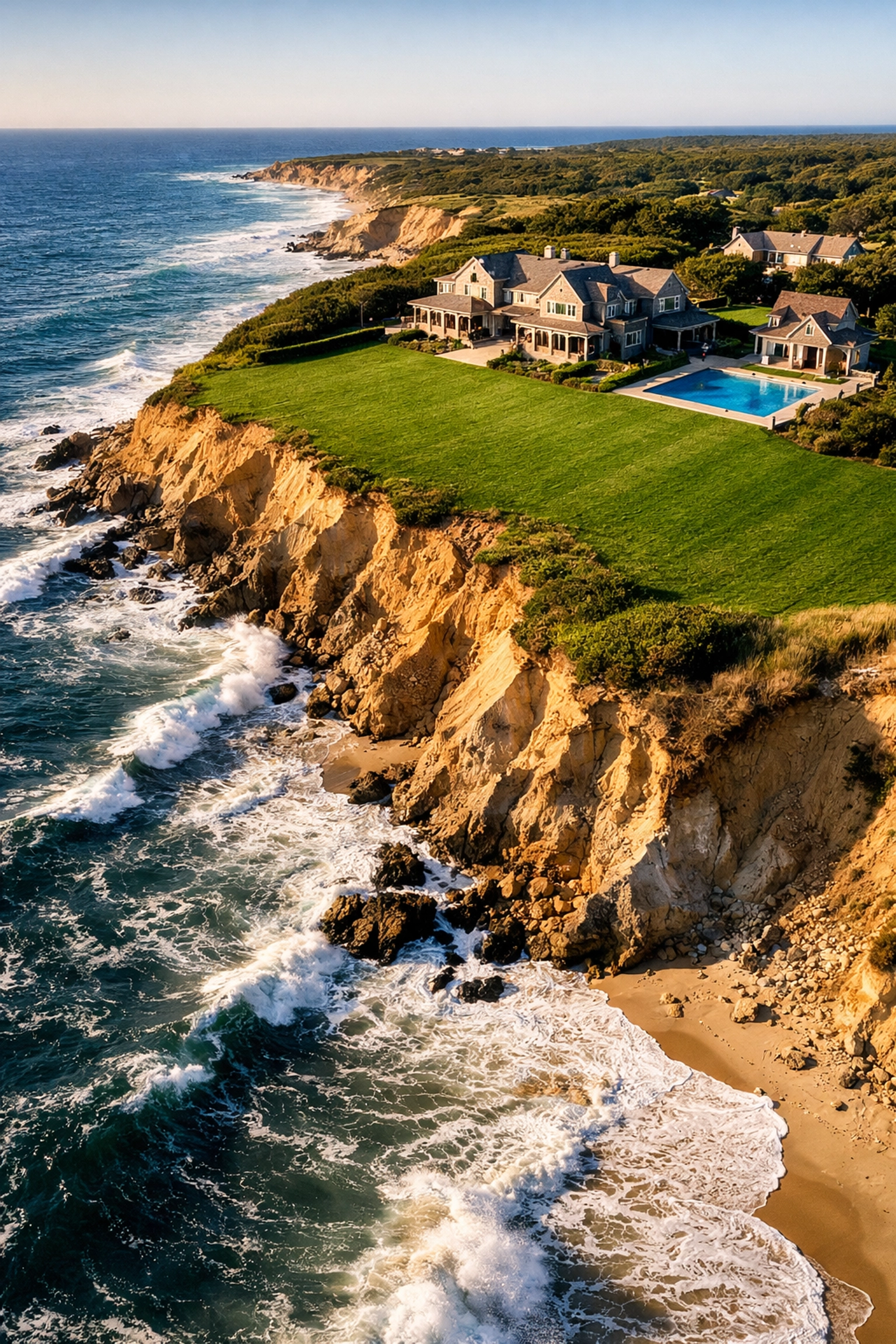
A visual representation of coastal erosion and its impact on property boundaries.
The Role of Expert Risk Assessment
Protecting a Vineyard home isn't just about buying a policy; it's about physical risk mitigation. Our team at Insure Connecticut LLC works with clients to identify vulnerabilities before the storm hits.
Wind and Water Mitigation
Storm Shutters: Permanent, high-quality shutters can significantly reduce wind-driven rain damage.
Sump Pump Sensors: WiFi-enabled sensors are non-negotiable for secondary homes.
Roof Integrity: Standard asphalt shingles often fail in 100mph+ gusts. Investing in hurricane-rated roofing materials can sometimes lead to premium credits.
Liability Beyond the Walls
A secondary home is often a place of hospitality. You host friends, extended family, and perhaps even charitable events. This increases your liability profile. If an accident occurs on your property, a standard liability limit of $500,000 is rarely enough for a high-net-worth individual. We often recommend integrating your Vineyard home into a comprehensive general liability and personal umbrella strategy.
Future Outlook: The Evolving Coastal Landscape
The insurance industry is currently undergoing a "correction." As climate modeling becomes more precise, insurers are adjusting their "appetite" for coastal risks. We expect to see:
Stricter Underwriting: More physical inspections and drone surveys of roofs and shorelines.
Parametric Insurance: A new trend where payouts are triggered by specific events (like a Category 3 hurricane hitting the island) rather than a traditional loss adjustment.
Mandatory Mitigation: Insurers may soon require smart-home technology or specific coastal reinforcements as a condition of coverage.
Understanding these trends is vital for any owner looking to preserve their property's value and their own peace of mind. You can see many of these trends discussed in expert YouTube videos on coastal construction and island engineering.

High-end interior of a Vineyard home showing fine art and valuables that require specialized coverage.
FAQs: What Martha's Vineyard Homeowners Ask Most
Does my Connecticut umbrella policy cover my Martha’s Vineyard home?
Generally, yes, a personal umbrella policy provides excess liability coverage over all your owned properties. However, it is critical to ensure that your Martha’s Vineyard primary policy has the "underlying limits" required by the umbrella carrier. If your Vineyard policy only has $300,000 in liability but your umbrella requires $500,000, you have a dangerous $200,000 gap.
What is a "Named Storm" deductible?
Unlike a standard deductible (which is a flat dollar amount), many coastal policies have a percentage-based deductible for "Named Storms" (hurricanes or tropical storms). If your home is insured for $2 million and you have a 5% Named Storm deductible, you are responsible for the first $100,000 of damage. Radical transparency requires us to state: this is where many homeowners feel "cheated" after a storm. Knowing your percentage is vital.
Can I insure my dock or pier?
Most standard homeowners policies exclude or severely limit coverage for docks, piers, and bulkheads. If you have a private waterfront installation, you need a specific endorsement or a separate marine policy.
Why is flood insurance separate?
A common misconception is that "homeowners insurance" covers water damage. It covers "falling water" (rain) but almost never "rising water" (storm surge/flood). Even if your mortgage company doesn't require it, we strongly advise flood insurance for nearly all island properties.
Is the Massachusetts FAIR Plan my only option if I’ve been non-renewed?
Not necessarily. While the private market is tighter, specialized brokers with access to "Excess and Surplus" lines or Private Client carriers can often find coverage that the FAIR Plan cannot match.
Conclusion: Securing Your Island Legacy
Protecting a home on Martha’s Vineyard requires more than a casual approach to insurance. It requires an understanding of the island's unique logistical challenges, the volatile coastal environment, and the limitations of standard insurance markets.
At Insure Connecticut LLC, we specialize in the "multi-state" lifestyle. We understand that your Vineyard home is a centerpiece of your family's life, and it deserves a primary insurance strategy that reflects its value and its risks. Whether you are looking for a comprehensive review of your current coverage or are in the process of acquiring a new piece of island paradise, our experts are here to guide you.
The Vineyard is a place of timeless beauty. Ensuring it stays that way for the next generation starts with a clear-eyed assessment of how you protect it today.
Your Next Step for Coastal Protection
Don't wait for hurricane season to review your coastal coverage. A proactive review can identify gaps in replacement costs, liability, and mitigation credits that could save you thousands in the event of a loss.
Contact Insure Connecticut, LLC today for a Private Client coverage review. 71 Raymond Road, West Hartford, CT 06107 860-440-7324 Explore our High-Value Home Insurance Services

Comments