.png)
Classic Car Valuations in 2026: Is Your Investment Protected?

As the March air begins to soften across Connecticut, many of us are heading into our garages in West Hartford, Litchfield, and along the shoreline to pull back the car covers. It is a ritual of spring. But as you prepare for the 2026 show season, there is a technical question that carries more weight today than it did even two years ago: Do you actually know what your car is worth in today’s stabilized market?
The landscape for collector car valuations has shifted significantly. We have moved past the post-pandemic "fever" where every vintage SUV and air-cooled Porsche seemed to double in price overnight. In 2026, the market is more discerning, more technical, and more stratified. At Insure Connecticut LLC, located right here at 71 Raymond Road in West Hartford, we’ve seen how these market shifts directly impact your financial security. If your insurance policy hasn't been updated to reflect 2026 valuations, you aren't just risking a few dollars, you’re risking the entire legacy of your investment.
Whether you are cruising to a local meet in Rocky Hill or taking a long weekend drive through the berkshires, understanding the difference between a standard auto policy and a specialized collector car policy is the most important maintenance task you’ll perform this year.
The High Stakes of Valuation: Agreed Value vs. Actual Cash Value
The most dangerous phrase in the world of collector cars is "Actual Cash Value" (ACV). Most standard auto insurance policies operate on this principle. If you drive a 2023 sedan as your daily commuter, ACV makes sense. The insurance company determines the value of the car at the time of the loss, accounting for depreciation.
However, for a classic or collector car, depreciation is often the enemy of reality. In 2026, we are seeing a massive "Value Gap" emerge. While a 1990s modern classic might be appreciating in the eyes of enthusiasts, a standard insurance adjuster might simply see a "35-year-old vehicle" with high maintenance costs.
Why Actual Cash Value Fails the Collector
When you insure a classic car under a standard policy, you are essentially giving the insurance company the power to decide what your car is worth after an accident happens. They will look at local auctions, "book values" that may not track with the enthusiast market, and general market trends for old cars.
In a year like 2026, where the gap between an "Excellent/Concours" condition car and a "Fair" condition car has widened significantly, an ACV policy will almost always trend toward the lower end of the spectrum. If you’ve spent $50,000 on a ground-up restoration of a Mustang, but the "market" for an average Mustang is $25,000, an ACV policy will leave you with a $25,000 hole in your pocket.
The Power of Agreed Value
At Insure Connecticut LLC, we emphasize Agreed Value coverage for our collector clients. This is a technical distinction that changes everything. With Agreed Value:
The Value is Set Up Front: You and the insurance company agree on the car’s value at the time the policy is written.
No Depreciation: If a total loss occurs, you are paid that exact amount, period.
Market Alignment: We use current 2026 data, including private sales and specialized auction results, to ensure the number reflects the real-world replacement cost of your specific vehicle.
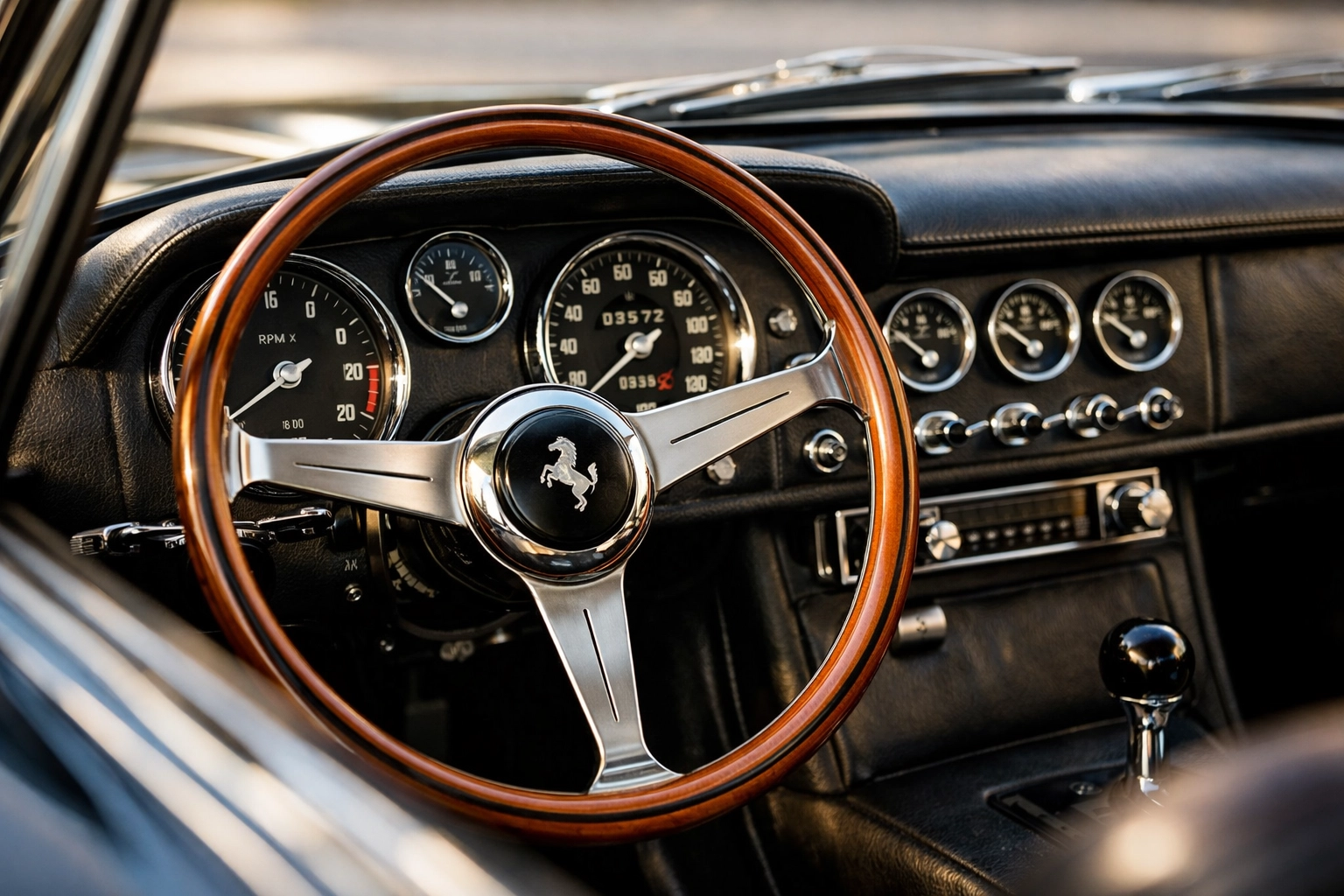
Alt-text: A close-up of a classic car's dashboard and steering wheel, representing the detail and value of vintage investments.
Navigating the 2026 Market Segments
To protect your investment, you must understand where your specific vehicle sits in the 2026 economic landscape. The "one size fits all" approach to car collecting is dead. Research shows that three distinct tiers have emerged this year, each requiring a different valuation strategy.
1. The Blue-Chip Icons
Six-figure vehicles, such as the Porsche 964, Ferrari Testarossa, and the Lamborghini Countach, have remained remarkably stable. Wealthy buyers are relatively insulated from the minor economic fluctuations of the mid-2020s. If you own one of these icons, your valuation needs to be precise. These cars are often part of a larger portfolio of assets that might include real estate investments or commercial holdings. Ensuring your car is covered for its true auction potential is vital.
2. The Rise of the "Modern Classic" (1990s-2000s)
This is the hottest segment of 2026. Vehicles like the Porsche Carrera GT are now crossing the $2 million mark, and more "attainable" heroes like the BMW E46 M3 or the early Acura NSX are seeing strong, consistent appreciation. The challenge here is that values are moving faster than traditional "blue books" can track. If you haven't adjusted your home and auto bundles to include a specific rider or a separate collector policy for these vehicles, you are likely underinsured.
3. Restomods and Performance Builds
Perhaps the most resilient segment in 2026 is the high-quality restomod. Today’s buyers prioritize driving enjoyment over factory-correct chalk marks. A vintage Bronco or Land Rover Defender with a modern drivetrain and climate control can often command higher prices than a bone-stock original. However, these are the hardest to value. You need an insurance partner who understands the cost of the components and the labor involved in these builds.
Best Practices for Protecting Your Asset
How do you ensure your valuation is bulletproof? It requires a proactive approach. You cannot wait for the renewal notice to think about your car's worth.
Documentation is King
In 2026, documentation isn't just a folder of receipts; it’s your insurance policy’s best friend.
Keep a Digital Trail: Store high-resolution photos of the engine, undercarriage, and interior.
Matching Numbers: If your car is a "matching numbers" example, ensure that is noted in your policy application.
Professional Appraisals: For cars valued over $100,000, a professional appraisal from a certified specialist is highly recommended every two to three years.
Analyze "Sold" Prices, Not "Asking" Prices
One of the biggest mistakes Connecticut collectors make is looking at what people are asking for cars on online marketplaces. Those numbers are often inflated. To get a true valuation for insurance purposes, you must look at actual "sold" data from the past 6 to 18 months. This provides a realistic baseline for what it would cost to replace your car in the current market.
Consider Inflation and Restoration Costs
Even though general inflation has cooled in 2026, the cost of specialized labor and rare parts has not. If your car is damaged, the cost to repair it with "period-correct" parts may be significantly higher than it was just a few years ago. This is why having a policy that offers liability insurance alongside comprehensive coverage is essential for the active driver.

Alt-text: A professional insurance agent reviewing paperwork with a classic car owner in an office setting.
2026 Trends: What Connecticut Drivers Need to Know
Connecticut has one of the most vibrant car cultures in the Northeast. From the "Caffeine & Carburetors" events in New Canaan to the shoreline cruises in Old Saybrook, our state’s collectors are active. But our unique environment also brings unique risks.
The "Barn Find" Myth vs. Reality
While everyone dreams of finding a rare Ferrari in a Litchfield County barn, the reality of 2026 is that the "Value Gap" has made unrestored cars a risky bet. Rising restoration costs mean that a car in "fair" condition might actually be losing value because it costs more to fix than the finished product is worth. If you are insuring a project car, you need "Builder's Risk" style coverage that increases in value as you hit restoration milestones.
Climate and Storage
Our Connecticut winters are harsh. Many collectors utilize climate-controlled storage facilities in the West Hartford area. Did you know that your property insurance might not fully cover your vehicle if the storage facility’s roof collapses? A dedicated collector car policy follows the vehicle, whether it’s in your garage, a storage unit, or on a trailer headed to a show.
Legal and Industry Shifts
In 2026, we are seeing more scrutiny on "stated amount" policies, which many people confuse with "agreed value." A stated amount policy allows you to state the value, but it still gives the insurance company the option to pay the ACV at the time of loss. It is a subtle but expensive distinction. At Insure Connecticut LLC, we help you cut through the jargon to ensure there are no surprises when you file a claim.
Frequently Asked Questions (FAQ)
1. How do I know if I have the right amount of coverage for my classic car? The best way is to compare your current policy’s "limit of liability" against recent sold prices of similar vehicles. If you see a discrepancy of more than 10%, you are underinsured. Contact us at 860-440-7324 for a professional valuation review.
2. Does my standard auto policy cover my car if I take it to a car show? Usually, yes, but only for basic liability. It won't account for the specialized value of your collector car, and many standard policies have exclusions for "exhibitions" or "organized events." A specialized policy is always the safer choice.
3. What is the difference between "Stated Amount" and "Agreed Value"? "Stated Amount" is often a maximum the company will pay, but they can still pay less if they deem the market value has dropped. "Agreed Value" is a guaranteed payout of that specific amount in the event of a total loss. Always aim for Agreed Value.
4. Can I bundle my classic car insurance with my home and business policies? Yes! Bundling can often lead to significant savings. We frequently help clients integrate their collector car coverage with their commercial insurance or personal home policies to simplify their lives.
5. How often should I update the valuation of my collector car? In a market like 2026, we recommend a review every 12 to 24 months. If you’ve performed significant work on the car or if the market for your specific model is trending upward (like modern classics), an annual review is best.
6. Does collector insurance have mileage restrictions? Many policies do, typically ranging from 2,500 to 5,000 miles per year. However, there are now "freedom to drive" tiers that allow for more usage while still maintaining the benefits of a collector policy.
Conclusion: Securing Your Automotive Legacy
Your classic car is more than just a machine; it’s a piece of history, a mechanical masterpiece, and a significant financial asset. In 2026, the "Value Gap" and the stabilization of the market mean that "set it and forget it" insurance is no longer a viable strategy. You need a partner who understands the nuances of the Connecticut car scene and the technical details of modern valuations.
At Insure Connecticut LLC, we pride ourselves on being more than just brokers: we are advocates for your peace of mind. Whether you’re protecting a vintage tractor on a farm in Simsbury or a million-dollar supercar in a West Hartford garage, our team at 71 Raymond Road is here to help.
Don't let a technicality in your policy turn a minor accident into a total financial loss. Let’s make sure your investment is as protected as it is polished.
Ready to review your classic car coverage? Call us today at 860-440-7324 or visit our office in West Hartford. Let’s talk cars and ensure yours is ready for the road ahead.

Comments