.png)
Risk Management: Navigating Surety Bonds and General Liability for CT Redemption Centers

Since the expansion of the Connecticut "Bottle Bill" in early 2024, which doubled the deposit from 5 cents to 10 cents, the redemption center business in the Constitution State has transformed. What used to be a niche side-operation for many has become a high-volume, high-stakes commercial enterprise. But with higher volume comes higher risk. If you are operating a redemption center in Hartford, New Haven, or anywhere in between, you aren’t just handling plastic and glass; you are managing a complex flow of state-regulated finances.
Navigating business insurance in CT for this specific industry requires more than a "standard" policy. You are required to hold specific financial guarantees, primarily surety bonds, while protecting your physical location from the constant foot traffic of the public.
In this guide, we are going to dive deep into the two pillars of protection for your center: Surety Bonds and General Liability. We will answer the "Big 5" questions, Cost, Problems, Comparisons, Reviews, and Best, to ensure you have a roadmap for your connecticut business insurance strategy that keeps your doors open and your compliance record clean.
What is a Surety Bond and Why Does a CT Redemption Center Need One?
Before we talk about traditional insurance, we have to talk about the "Entry Ticket" for redemption centers: the Surety Bond.
In the eyes of the Connecticut Department of Energy and Environmental Protection (DEEP), a redemption center is a vital link in the state’s environmental infrastructure. Because you handle deposits that belong to the state or the distributors, the state needs a guarantee that you will play by the rules.
A surety bond is not insurance for you; it is a financial guarantee for the benefit of someone else. In this case, the bond ensures that you will fulfill your obligations under the CT Bottle Bill regulations. If you fail to pay out deposits correctly or violate state administrative rules, the bond provides a pool of money that the state can claim against to rectify the situation.
The Anatomy of the Bond
The Principal: You (the redemption center owner).
The Obligee: The State of Connecticut (the party requiring the bond).
The Surety: The insurance company that issues the bond.
Risk Level Gradient: Compliance vs. Financial Exposure [ Low Risk | #####################----------------- | High Risk ] Maintaining strict accounting reduces bond claim risk.
The "Big 5": Cost, Problems, Comparisons, Reviews, and the Best
To help you make an informed decision about your small business insurance in CT, let’s break down the most common questions center owners ask us.
1. How Much Do Surety Bonds and General Liability Cost in CT?
Price is always the first question. For a Connecticut redemption center, your costs are split between your bond premium and your liability premiums.
Surety Bond Cost: Typically, you aren't paying the full face value of the bond. If the state requires a $10,000 or $25,000 bond, you pay a "premium" which is usually 1% to 3% of the bond amount annually, provided you have good credit. If your credit is challenged, that rate can jump to 5% or 10%.
General Liability (GL) Cost: For a standard 1,500 to 2,500 square foot redemption center in CT, you can expect to pay anywhere from $800 to $1,800 per year for General Liability.
CT Insurance Stat: The average cost for small business general liability in Connecticut is roughly $1,020 annually, though redemption centers often trend slightly higher due to "Slip and Fall" risks associated with wet floors and broken glass.
2. What Problems Should I Anticipate?
Transparency is key. We don't want you to think insurance covers everything.
The "Bond Claim" Nightmare: If a distributor claims you aren't properly counting containers or are over-reporting to get higher handling fees, they can file a claim against your bond. Unlike insurance, you must pay the surety company back for any money they pay out on a claim.
The Wet Floor Hazard: Redemption centers are notoriously messy. Sticky soda residue and melted ice create a constant slip hazard. If a customer falls, a standard GL policy will cover the legal fees and medical bills, but frequent claims will cause your premiums to skyrocket or lead to non-renewal.
Exclusions: Most GL policies for redemption centers will exclude "Pollution." If a chemical or hazardous material is dropped off at your center and leaks into the ground, a basic policy won't help you. You may need specialized commercial lines insurance policies to cover environmental mishaps.
3. Comparison: Surety Bonds vs. General Liability
Many owners confuse the two. Here is the breakdown:
Feature | Surety Bond | General Liability |
Who is it for? | Protects the State/Distributors | Protects Your Business |
Is it mandatory? | Yes, by CT Law for licensing | Often required by Landlords/Lenders |
Do you pay back claims? | Yes | No (usually just your deductible) |
What does it cover? | Regulatory compliance and honesty | Bodily injury and property damage |
4. Reviews: What Are Other Owners Saying?
If you browse Reddit’s r/Connecticut or business forums, you’ll see a common theme: "The bond was easy to get, but the liability insurance was hard to find."
Because redemption centers involve "recycling" and "waste," many standard insurance companies (like the ones you see on TV commercials) view them as too risky. Owners often find that they need to work with a specialized broker who has access to the "Excess and Surplus" lines, insurance companies that specialize in higher-risk industries.
5. What is the "Best" Insurance Setup?
The best setup is a Business Owners Policy (BOP) tailored for redemption centers. A BOP bundles General Liability with Property Insurance (to cover your balers, counters, and computers).
Check out our Connecticut Business Owners Policy page to see how these bundles work. For a redemption center, the "Best" policy also includes a "Hired and Non-Owned Auto" endorsement if you have employees running to the bank or picking up supplies in their personal vehicles.
General Liability: Protecting Your "Brick and Mortar"
While the bond keeps you legal, General Liability keeps you in business. In a redemption center, you have a constant stream of people carrying heavy bags, maneuvering carts, and interacting with machinery.
Why Slip and Fall is Your Biggest Threat
Connecticut winters are brutal. Customers track in snow and salt. Combined with the liquid residue from cans, your floors become ice rinks.
Actionable Tip: Install high-visibility floor markers and heavy-duty rubber matting at every entrance and machine station.
Pro-Tip: Keep a "Sweep Log." If you can prove in court that you swept and mopped every 60 minutes, it becomes much harder for a plaintiff to prove negligence in a slip-and-fall case.
Property Coverage for Your Equipment
A modern redemption center relies on expensive automated reverse vending machines (RVMs) and industrial balers. If a fire or a pipe burst ruins this equipment, your General Liability won't pay to fix it, you need Property Coverage.
Note: Ensure your equipment is covered at "Replacement Cost" rather than "Actual Cash Value." If a five-year-old baler breaks, you want enough money to buy a new one, not the depreciated value of the old one.
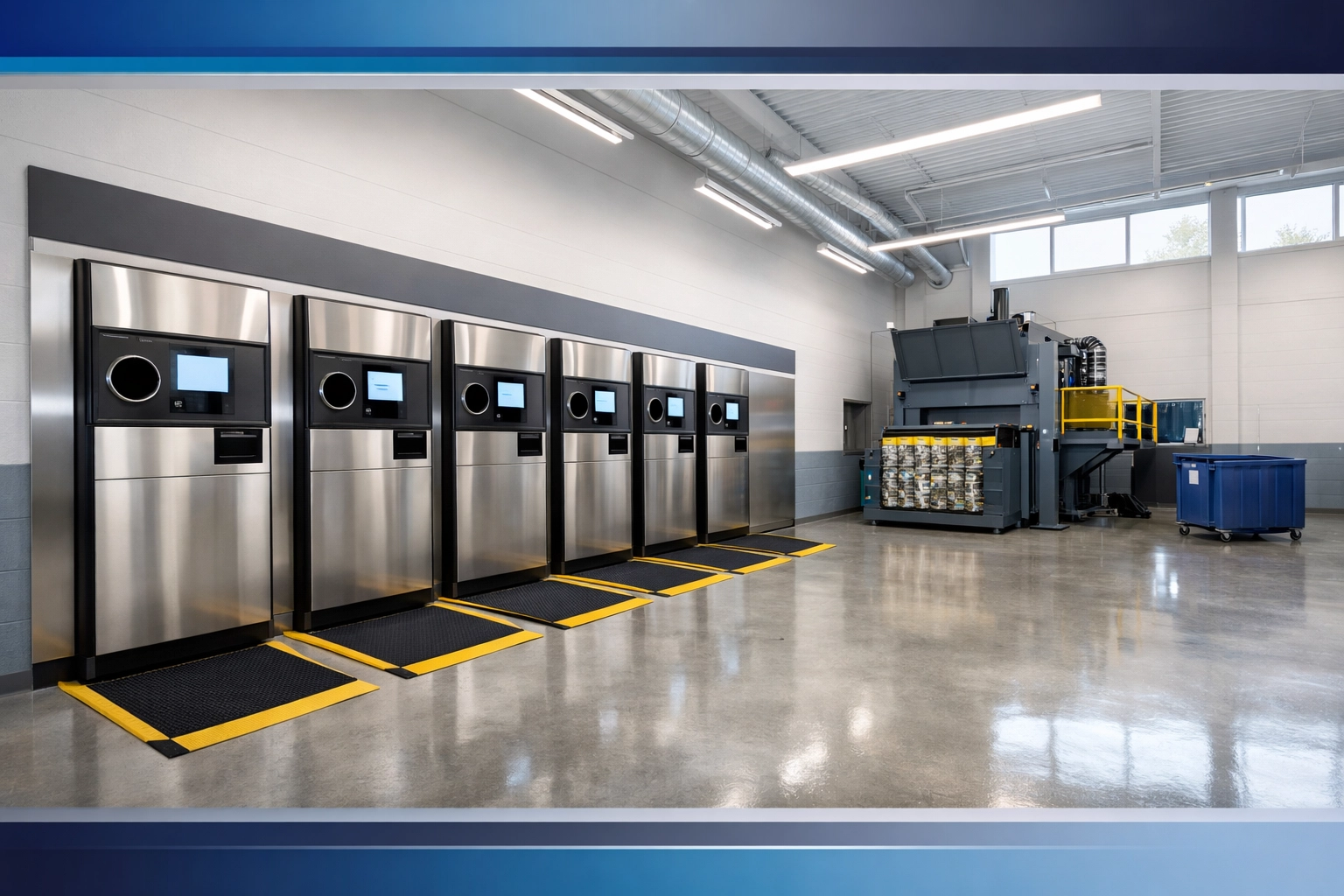
(Suggested Image: A clean, well-lit interior of a Connecticut redemption center showing safety mats and organized sorting stations.)
Managing the Risk of Employees
You can’t run a high-volume center alone. But employees bring a whole new set of risks.
Workers’ Compensation
In Connecticut, if you have one or more employees, you are legally required to carry Workers’ Compensation. Redemption centers have high "soft tissue" injury rates, backs, shoulders, and wrists from lifting heavy bags of glass.
Prevention: Invest in "Lift Assist" tools and mandate the use of cut-resistant gloves. A single worker's comp claim can raise your rates for three years.
Employment Practices Liability Insurance (EPLI)
Have you considered what happens if an employee sues you for wrongful termination or harassment? In the fast-paced, often stressful environment of a busy Saturday morning at a redemption center, tempers can flare. EPLI insurance protects your business from the legal costs of these disputes.
Cost Comparison Gradient: Annual Premiums by Coverage Type [ GL: $1k | ###########-------------------------- | Workers Comp: $3k+ ] Workers Comp is often the most expensive line due to manual labor risks.
The Application Process: What to Prepare
When you call an agent for connecticut business insurance, don't go in empty-handed. To get the best rates, you should have the following ready:
Gross Sales Projections: With the 10-cent deposit, your "gross sales" numbers might look inflated. Be sure to clarify what is "pass-through" deposit money vs. actual "handling fee" revenue.
Square Footage: Accurate measurements of your customer area vs. your warehouse area.
Safety Procedures: A written safety manual (even if it's just two pages) shows underwriters you are a "preferred risk."
FEIN and Business Entity Docs: Whether you are an LLC or a S-Corp matters for your bond application.
If you are just starting out, you might find our About Insure Connecticut page helpful to understand how we advocate for small businesses during this application phase.
Current Trends: The Digital Shift and Cyber Risk
Believe it or not, redemption centers are becoming tech hubs. Many centers now use proprietary software to track volumes and pay out customers via digital apps or store credit.
Cyber Liability
If you store customer data or use a networked point-of-sale system, you are a target for hackers. A breach could shut down your ability to process returns, leading to a massive loss of income. Cyber liability insurance is no longer just for big tech companies; it's for anyone with an internet connection and a cash drawer.
The "Volume Surge" Trend
As more people realize that a bag of 100 cans is now worth $10 instead of $5, the traffic at redemption centers is expected to grow by 30-40% across Connecticut. This means more trucks on your property. If you own the building, you need to ensure your "General Liability" limits are high enough to handle the increased "Aggregated Risk."
For a visual breakdown of how surety bonds work in the broader context of business, this YouTube video on Surety Bond Basics is a great 5-minute refresher.
Common Questions About Redemption Center Insurance (FAQ)
Q: Do I need a bond for every location I open? A: Usually, yes. The Connecticut DEEP typically requires a separate bond or an increased bond amount for each licensed facility to ensure each location is compliant.
Q: Can I use a Personal Umbrella policy for my business? A: No. Personal insurance policies almost universally exclude business activities. You need a Commercial Umbrella policy to sit on top of your General Liability.
Q: What happens if my bond is cancelled? A: If your surety company cancels your bond (usually due to non-payment or a filed claim), the State of Connecticut will move to suspend your license. You cannot operate a redemption center without a valid bond on file.
Q: Does my insurance cover the value of the cans in my warehouse? A: This is tricky. Cans are "Stock." You need to ensure your Property Insurance includes "Stock" coverage. However, the value of a can is its scrap value plus the deposit. Make sure your agent understands this "dual value" so you aren't underinsured.
Q: Why is my Workers' Comp rate so high? A: Redemption centers are classified similarly to "Recycling Centers" or "Wholesale Merchants." These categories have higher-than-average injury rates. Implementing a formal safety program can help you qualify for "Scheduled Credits" (discounts) on your premium.
Final Thoughts: Building a Resilient Business
Running a redemption center in Connecticut is a service to the community and the environment, but it is also a tightrope walk of regulatory compliance and physical risk. By securing a robust surety bond and a comprehensive General Liability policy, you aren't just "buying a piece of paper": you are building a foundation that allows you to scale as the Bottle Bill continues to evolve.
At Insure Connecticut LLC, we live and work in the same communities you serve. We understand that a redemption center in West Hartford faces different challenges than one in a rural part of Litchfield County. Whether you are looking for a new business insurance quote or just want a second set of eyes on your current bond, we are here to help you navigate the process with transparency and expertise.
Next Steps:
Review your current bond limit. Is it sufficient for the 10-cent deposit volumes?
Inspect your floors. Do you have a documented cleaning schedule?
Check your equipment list. Is your new baler actually listed on your policy?
If you're ready to get started, or just want to compare your current rates against the CT average, reach out to us today. We’ll help you take the guesswork out of your risk management strategy.
Insure Connecticut, LLC, DBA, InsureCT 71 Raymond Road, West Hartford, CT 06107 860-440-7324

Comments